RBI Repo Rate Impact on Your Loan EMI
MBA Finance | CFA | Ex-Banker
Published March 07, 2026
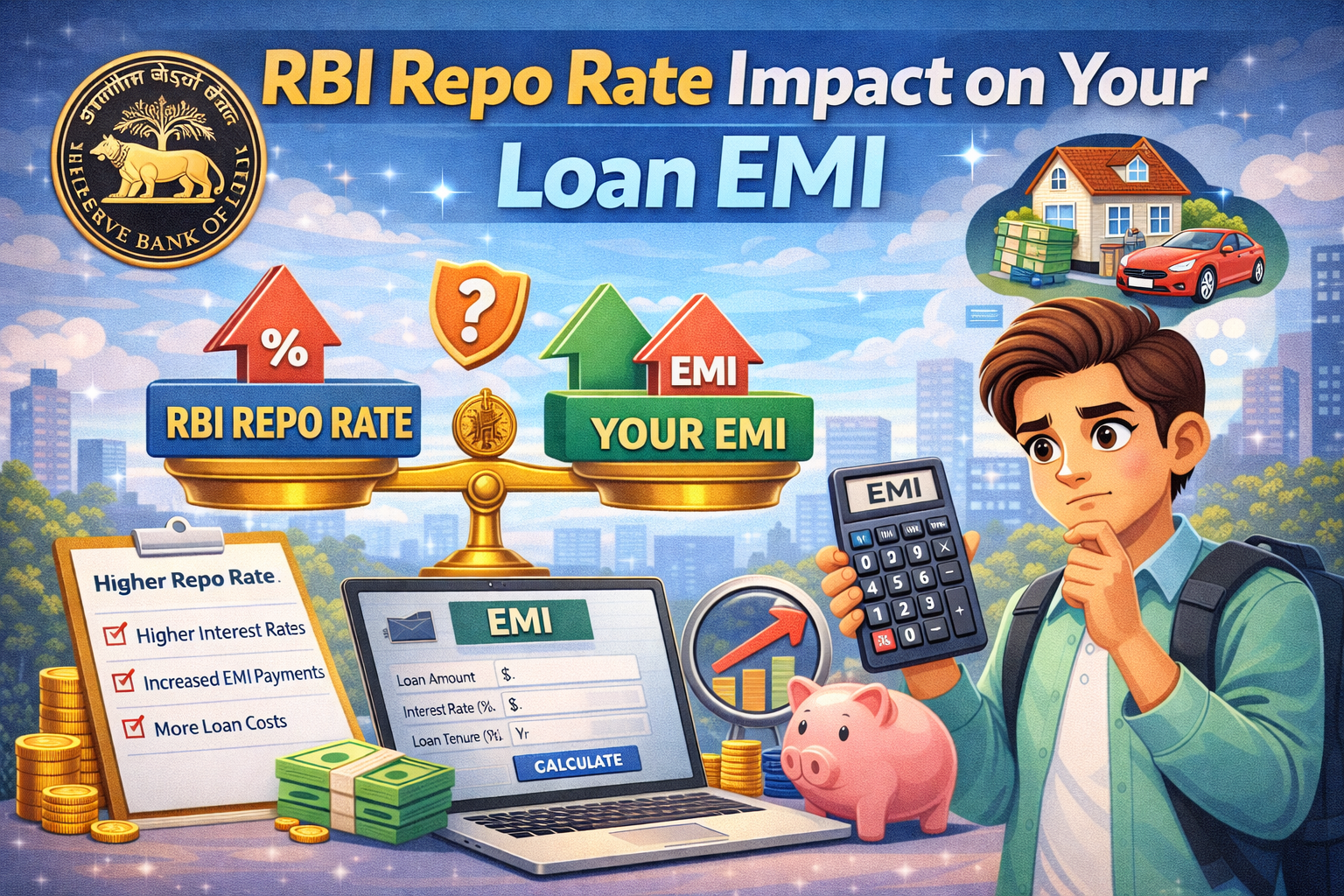
RBI Repo Rate Impact on Your Loan EMI
The RBI repo rate plays a very important role in determining the interest rates of loans in India. Whenever the Reserve Bank of India (RBI) changes the repo rate, it directly or indirectly affects the loan interest rates offered by banks and financial institutions. As a result, your monthly EMI (Equated Monthly Installment) can increase or decrease depending on the repo rate movement.
Many borrowers do not fully understand how repo rate changes impact their home loans, car loans, or personal loans. However, even a small change in the repo rate can significantly affect the total cost of a loan over time.
In this guide, we will explain what the repo rate is, how it affects loan interest rates, and how it can impact your EMI payments.
What is the RBI Repo Rate?
The repo rate is the interest rate at which the Reserve Bank of India lends money to commercial banks for short-term needs. When banks need funds to maintain liquidity, they borrow money from the RBI and pay interest based on the repo rate.
The repo rate is one of the main tools used by the RBI to control inflation and maintain economic stability in the country.
If the RBI increases the repo rate, borrowing money becomes more expensive for banks. As a result, banks usually increase the interest rates on loans. On the other hand, if the RBI reduces the repo rate, banks can borrow money at a lower cost and may reduce loan interest rates.
Current RBI Repo Rate Trend
The repo rate changes periodically depending on economic conditions such as inflation, economic growth, and market liquidity. When inflation rises, the RBI may increase the repo rate to reduce excessive borrowing and spending in the economy.
Similarly, when the economy needs support and growth, the RBI may reduce the repo rate to encourage borrowing and investment.
How Repo Rate Affects Loan Interest Rates
Banks determine their lending rates based on several factors, including the RBI repo rate. Many loans today are linked to external benchmark rates such as the repo rate. This means that changes in the repo rate are quickly reflected in loan interest rates.
For example, if the repo rate increases by 0.50%, banks may increase their lending rates by a similar margin. This means borrowers will need to pay higher interest on their loans.
Similarly, if the repo rate decreases, banks may reduce loan interest rates, which can reduce the EMI amount or shorten the loan tenure.
Impact of Repo Rate on Different Types of Loans
Repo rate changes do not affect all loans equally. The impact depends on whether the loan has a fixed interest rate or a floating interest rate.
Loans with floating interest rates are directly affected by repo rate changes, while fixed-rate loans usually remain unaffected during the fixed-rate period.
| Loan Type | Impact of Repo Rate | Common Interest Type |
|---|---|---|
| Home Loan | Highly affected | Floating |
| Car Loan | Moderately affected | Fixed or Floating |
| Personal Loan | Less affected | Mostly Fixed |
| Business Loan | Moderately affected | Floating |
Example: Repo Rate Increase and EMI Impact
Let us understand how repo rate changes can affect your loan EMI with a simple example.
| Loan Amount | Interest Rate | Tenure | Monthly EMI |
|---|---|---|---|
| ₹30,00,000 | 8.50% | 20 Years | ₹26,035 |
| ₹30,00,000 | 9.00% | 20 Years | ₹26,992 |
As you can see, even a small increase of 0.50% in the interest rate can increase the EMI significantly over the loan tenure.
How Banks Adjust EMIs After Repo Rate Change
When interest rates change, banks usually adjust your loan in one of the following ways:
Increase or decrease the EMI amount while keeping the tenure the same.
Increase or decrease the loan tenure while keeping the EMI amount the same.
Most banks prefer adjusting the loan tenure instead of changing the EMI amount because borrowers are more comfortable paying the same monthly installment.
How Borrowers Can Manage Repo Rate Changes
Repo rate changes are beyond the control of borrowers, but there are some smart strategies that can help reduce the impact.
Make Prepayments: Paying extra towards your loan principal can reduce the outstanding balance and lower the interest burden.
Choose Shorter Tenure: Shorter loan tenure reduces the overall interest paid over time.
Maintain Good Credit Score: Borrowers with high credit scores often receive lower interest rates from banks.
Consider Balance Transfer: If another bank offers a lower interest rate, transferring the loan may reduce EMI costs.
Repo Rate vs Reverse Repo Rate
The reverse repo rate is another important policy rate set by the RBI. It is the interest rate at which the RBI borrows money from commercial banks.
While the repo rate encourages banks to borrow money, the reverse repo rate encourages banks to park their surplus funds with the RBI. Both rates are used by the RBI to control liquidity in the economy.
Why Repo Rate Matters for Borrowers
Understanding repo rate movements can help borrowers make better financial decisions. When repo rates are low, it may be a good time to apply for loans because interest rates are generally lower.
On the other hand, when repo rates rise, borrowers may face higher loan costs. Being aware of these trends can help you plan your finances more effectively.
Conclusion
The RBI repo rate plays a crucial role in determining loan interest rates in India. Any increase or decrease in the repo rate can directly affect the cost of borrowing and your monthly EMI payments.
Borrowers with floating-rate loans are especially sensitive to repo rate changes. Understanding how these changes work can help you manage your loans better and make smarter financial decisions.
By monitoring repo rate trends, maintaining a good credit score, and planning repayments wisely, borrowers can reduce the impact of interest rate fluctuations and maintain financial stability.
Financial Tip: Always check whether your loan is linked to the repo rate or another benchmark rate before applying, as this determines how quickly your EMI will change when RBI adjusts policy rates.
About the Author
Admin
MBA Finance | CFA | Ex-Banker
Financial expert with 15+ years of experience in banking and personal finance.